Cordless Tool Battery Care: Make Your Batteries Last Years Longer
Cordless tool batteries are the most expensive consumable in your workshop. A few simple charging and storage habits can keep them running strong for years instead of dying early.
Batteries are the most expensive part of going cordless — often costing more than the tool they power. The good news is that lithium-ion packs are tough, and they don’t need much from you: charge them sensibly, store them at a reasonable temperature and charge level, and they’ll serve you for years. Here’s the routine, plus the myths you can safely ignore.
On This Page
- Charging Habits That Matter
- Storage: The Big One
- Temperature Rules
- Small Daily Habits
- Myths You Can Ignore
- When to Retire a Battery
- Key Takeaways
- FAQs
Charging Habits That Matter
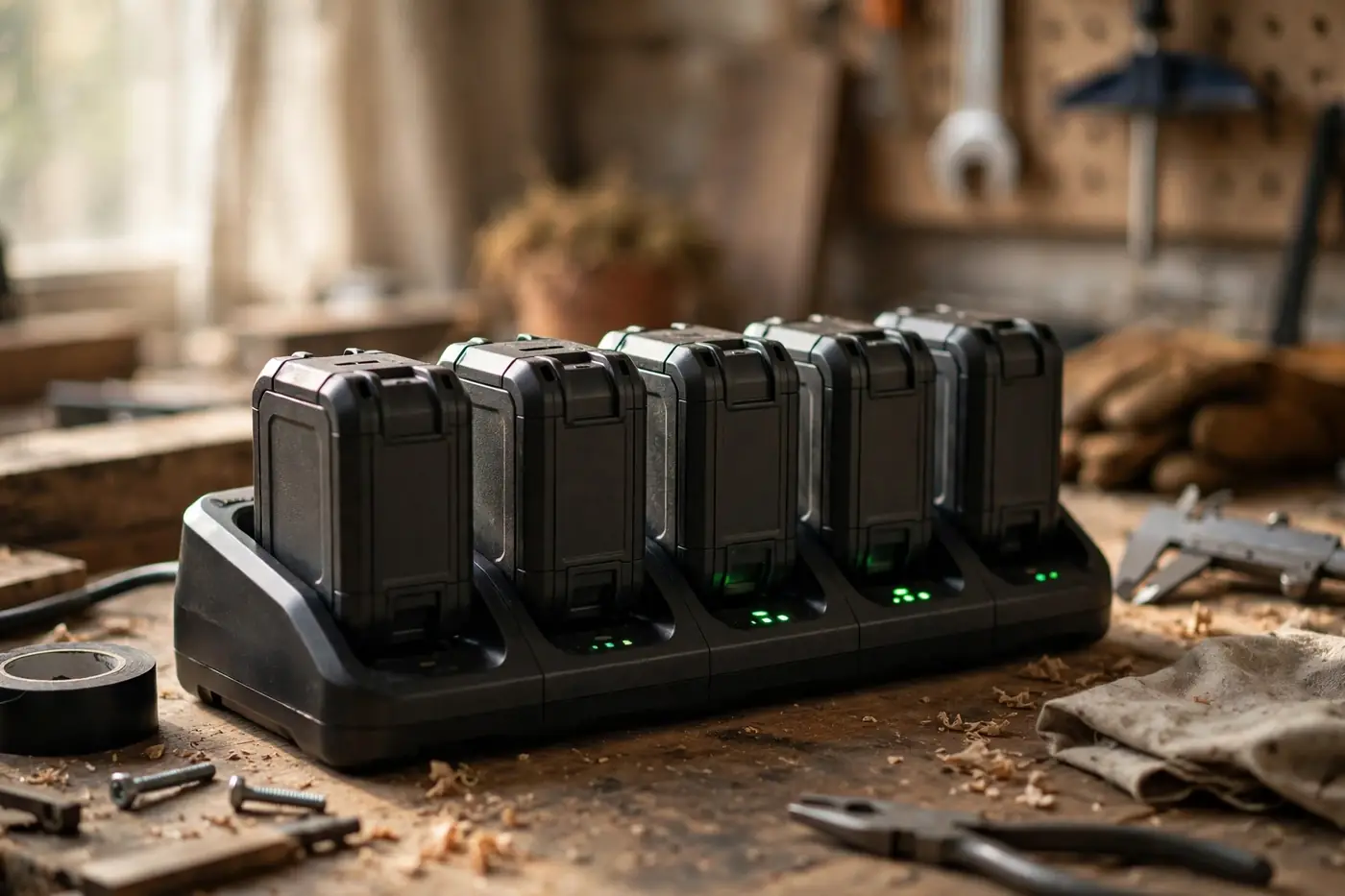
Modern lithium-ion tool batteries have built-in management electronics that handle most of the hard work — monitoring cell voltage, temperature, and charge state. You can’t really overcharge a healthy pack by leaving it on a modern charger; the charger stops when the pack is full. That said, a few habits genuinely help.
Charge before they’re completely dead
Lithium-ion packs prefer partial discharges over deep ones. You don’t need to baby this — the tool will usually slow or stop when voltage drops too low — but as a rule of thumb, swap in a fresh battery when you notice power fading rather than squeezing out the last gasp. If your tools have battery fuel gauges, swapping around one bar left is a good habit.
Let hot batteries cool before charging
After heavy work — ripping lumber, grinding metal, driving dozens of lag bolts — a battery comes off the tool warm. Charging a hot pack adds heat to heat, and heat is the main thing that ages lithium cells. Set the pack aside for 15–20 minutes to cool to room temperature, then charge it. Most chargers will refuse a genuinely overheated pack anyway (you’ll see a flashing error light), but giving it a rest first keeps you working instead of waiting on a fault.
Use the right charger
Stick with chargers made for your battery platform. Within the same voltage line, a brand’s chargers generally work across amp-hour ratings — but 12V and 18V-class systems need separate chargers, so a 12V pack won’t charge on an 18V charger and vice versa. A charger from a different brand won’t physically fit — and shouldn’t be jury-rigged to fit. Third-party “compatible” chargers exist, but a failed charger can damage an expensive pack, so the official one is the safer bet.
Unplug finished batteries if you’ll remember
Leaving a pack on the charger overnight won’t hurt it — the charger cuts off. But if you’re the organized type, pulling finished batteries off the charger keeps your bench tidy and your packs at whatever level they finished at. Either way works; don’t lose sleep over it.
Storage: The Big One
How you store batteries matters more than how you charge them, because storage is where packs spend most of their lives. Two things matter: charge level and environment.
Store at partial charge, not full and not empty
The sweet spot for long-term storage is roughly a 40–60% charge — most fuel gauges show this as two bars out of four, or thereabouts. A pack stored fully charged for months ages faster; a pack stored fully depleted can drop so low that its protection circuit won’t let it charge again.
In practice, this means: after a project, if a battery reads full, run it in a tool for a few minutes before shelving it. If it reads nearly empty, give it a partial charge. This sounds fussy, but it takes thirty seconds and it’s the single highest-leverage habit in this whole article — especially for batteries that sit unused over winter.
Store them like you’d store anything valuable
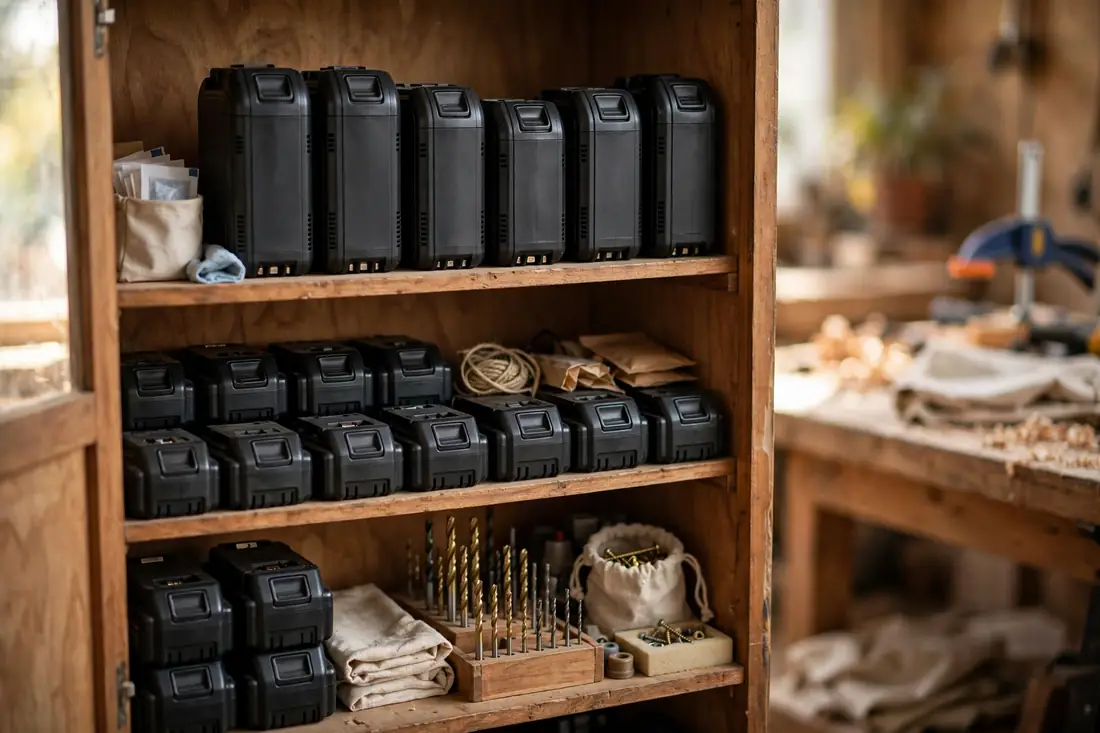
Batteries want what the rest of your tools want: a dry place off the floor, out of direct sun, away from solvents and sawdust piles. A shelf or cabinet in a climate-controlled space is ideal. Avoid tossing them loose in a toolbox where the terminals can short against metal objects — most packs have terminal covers or recessed contacts, but a bit of care costs nothing. If you’re reorganizing the shop, our tool storage ideas cover battery-friendly setups.
Check on stored batteries seasonally
Lithium packs self-discharge slowly. If batteries sit for six months untouched, give them a check: anything near empty gets a partial charge back up to the storage zone. A calendar reminder twice a year is plenty.
Temperature Rules
If there’s one environmental rule for lithium batteries, it’s this: heat is the enemy, cold is a temporary inconvenience.
Heat
High heat accelerates the chemical aging inside cells — permanently. Don’t leave batteries in a car trunk in a Texas summer, on a sun-baked dashboard, or leaning against a running generator. A garage that hits 100°F-plus in August will age packs faster than a climate-controlled shop; if your garage is the only option, at least keep batteries in an insulated cabinet away from the hottest wall. Never charge a pack that’s hot to the touch.
Cold
Cold doesn’t permanently damage a lithium pack the way heat does, but it temporarily reduces the power it can deliver — your tools will feel weak and runtime will drop. The fix is simple: bring cold batteries indoors and let them warm to room temperature before use. Don’t try to “warm them up” by charging them cold; let them normalize first, then charge if needed. For winter work, keep spare packs in an inside pocket or a warm vehicle between uses.
The practical range
Think of it this way: if you’re comfortable, your batteries are comfortable. Room temperature — roughly 50–80°F — is the happy zone for charging, using, and storing. Extremes in either direction deserve a pause and a workaround, not panic.
Small Daily Habits
Beyond charging and storage, a few small habits keep packs healthy and safe:
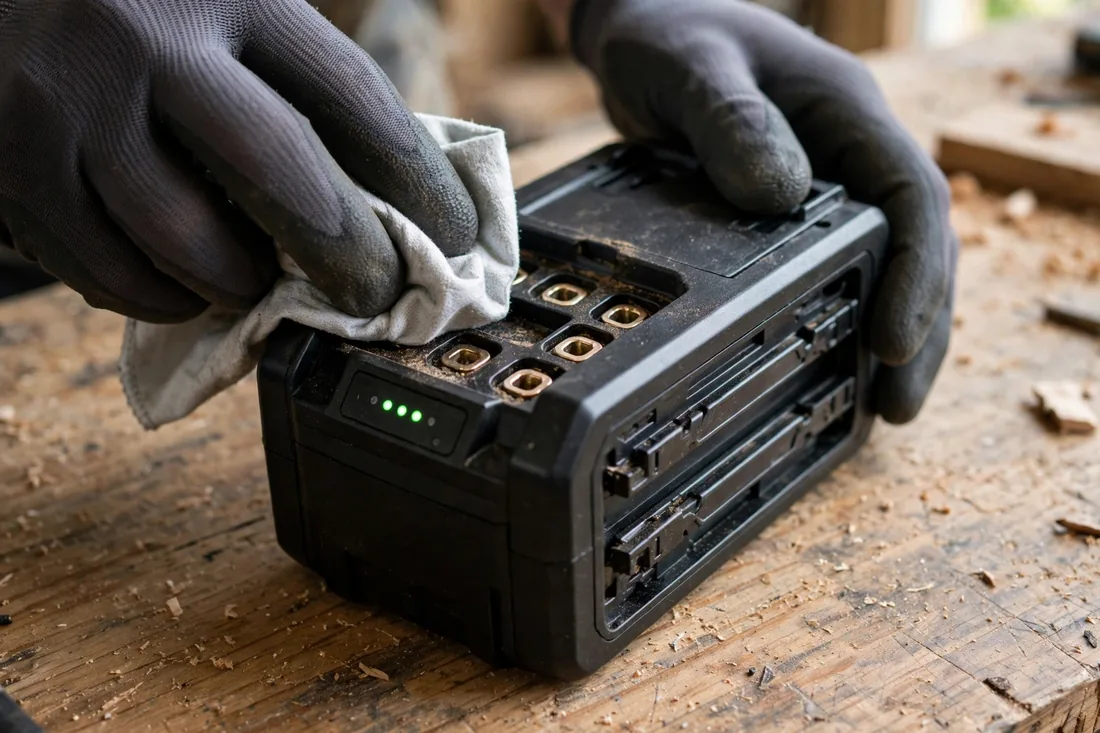
- Keep the terminals clean. Sawdust and grime on the metal contacts cause poor connections and heat. Wipe them with a dry cloth now and then; a cotton swab handles the recesses.
- Don’t use a damaged pack. Cracked housings, swollen cases, or batteries that get unusually hot are done — retire them. A swollen lithium pack is a fire risk; don’t puncture it, don’t toss it in the trash, and take it to a battery recycling drop-off.
- Keep batteries dry. Rain on the job site happens, but don’t leave packs sitting in puddles or charge a wet battery. Dry it thoroughly first.
- Rotate your packs. If you own four batteries and always grab the same two, the others age on the shelf while the favorites wear out. Rotate through them.
- Transport them sensibly. In a truck bed or trailer, batteries ride better in a case or bag than bouncing loose. Extreme vibration isn’t their friend.
Myths You Can Ignore
Battery advice from the nickel-cadmium era refuses to die. Here’s what doesn’t apply to your modern lithium-ion packs:
- “You must fully discharge before recharging.” That was nickel-based memory effect. Lithium-ion has no memory effect — partial charges are actually better.
- “Leaving it on the charger overnight ruins it.” Modern chargers and pack electronics cut off at full. It’s not ideal as a permanent lifestyle, but an overnight charge won’t kill a pack.
- “Freezing a battery revives it.” No. Freezing doesn’t restore capacity and can damage cells. A dead pack is a dead pack.
- “All batteries of the same voltage are interchangeable.” Voltage is only part of the story. Packs are keyed to their platform’s physical and electronic interface — and mixing brands with adapters can bypass safety electronics. Stay on your platform.
- “Bigger amp-hours always mean proportionally more life.” Mostly true in theory, but heavier packs also make tools clumsier, and in light-duty tools a smaller pack often delivers a better working experience.
Speaking of platforms: if you’re still deciding which battery family to commit to, read our guide to choosing a battery platform before you accumulate a shelf of incompatible packs.
When to Retire a Battery
Even with perfect care, lithium packs wear out — most tool batteries are generally considered to last a few hundred charge cycles, though real-world lifespan varies enormously with heat exposure and usage patterns. Signs yours is done:
- Runtime has dropped to a fraction of what it used to be, even after a full charge.
- The pack gets unusually hot during normal charging or light use.
- The fuel gauge behaves erratically — full one minute, dead the next.
- The case is swollen, cracked, or damaged.
Retired lithium packs don’t go in the household trash. Most home-improvement stores and many municipalities run battery recycling drop-offs — tape the terminals, bag the pack, and drop it off. It’s free and keeps hazardous material out of landfills.
Key Takeaways
- Store batteries at roughly half charge in a cool, dry place — this matters more than any charging trick.
- Let hot packs cool before charging, and don’t charge or use batteries at temperature extremes.
- Partial charges are fine; deep discharges and long-term full charges age packs faster.
- Ignore nickel-era myths: no memory effect, no freezer revival, no full-discharge requirement.
- Retire swollen, cracked, or rapidly fading packs, and recycle them — never trash them.
FAQs
Can I leave my batteries on the charger all the time?
Occasionally, yes — modern chargers stop at full. As a permanent habit it’s not ideal, since packs sit at 100% indefinitely, which ages cells faster than partial charge. If you want always-ready batteries, it’s a trade-off you’re allowed to make consciously.
How long do cordless tool batteries last?
It varies widely with heat, usage, and care, but a well-treated lithium pack commonly serves several years of homeowner use. Heavy daily professional use wears them faster. Heat exposure is the biggest lifespan killer — more than charge cycles.
Is it bad to use a fast charger?
Fast charging generates more heat, and heat ages cells. For daily use it’s fine — chargers and packs are designed for it — but if you’re not in a hurry, a standard charge is gentler. Avoid fast-charging a hot pack.
Can I store batteries in my garage?
Yes, if the garage stays reasonably temperate. The concern is extreme heat (summer garages in hot climates) and freezing winters. In a hot climate, move batteries to a climate-controlled space for summer storage.
Why did my battery die over winter?
Most likely it was stored fully charged or fully depleted in the cold for months. Cold plus an extreme charge state accelerates aging, and a deeply depleted pack can drop below the voltage its protection circuit allows. Store at partial charge and check seasonally.
Your Next Step
Today, go look at your batteries: anything sitting at full charge that won’t be used this week, run down a bit; anything near empty, top up to about half. Find them a cool, dry shelf off the garage floor. That ten-minute reset — plus the corded vs cordless perspective if you’re still building out your kit — is most of battery care there is.